

If you spend enough time around endurance athletes, you'll eventually hear someone swear by tart cherry. It usually comes up after a hard block of training, or in the days before a big race, and it's almost always mentioned in the same breath as recovery. What most people don't realise is that the active ingredient doing the heavy lifting isn't the cherry itself but a group of deep-red plant pigments called anthocyanins. Understanding the role of anthocyanins in sport is the difference between throwing money at a trendy supplement and actually using it in a way that supports your training.
I've spent years fuelling long rides and back-to-back running weeks, and I've become increasingly sceptical of recovery products that promise the earth. Tart cherry is one of the few that has genuinely earned its place in the peer-reviewed literature. This isn't about miracle cures — it's about a measurable, repeatable effect on muscle soreness, inflammation and even sleep, all of which matter when you're trying to string together consistent training. Let's get into what anthocyanins actually do and how to use them properly.
Quick answer: anthocyanins are the deep-red flavonoid pigments in fruits like Montmorency tart cherries, and research links them to reduced muscle soreness, lower oxidative stress and better sleep in athletes. Use them strategically: load for four to five days before a big event, continue through it, and keep going for two to three days afterwards.

What Are Anthocyanins and Where Do They Come From?
Anthocyanins are a subclass of flavonoids — the pigments responsible for the red, purple and blue colours you see in fruits like tart cherries, blackcurrants, blueberries and elderberries. They're not unique to cherries, but Montmorency tart cherries happen to be an exceptionally rich source, containing roughly 40–50mg of anthocyanins per 100g of fruit, with cyanidin-3-glucosylrutinoside and cyanidin-3-rutinoside making up the bulk of it.
Biologically, these compounds are the plant's own defence system, protecting the fruit from ultraviolet damage and oxidative stress. When you consume them, a portion of that protective capacity carries over to you. Anthocyanins act as antioxidants, mopping up the free radicals your body produces during hard exercise, and they also modulate the inflammatory response rather than blunting it entirely. That distinction matters, and I'll come back to it.
The Science: Why Anthocyanins in Sport Actually Work
The reason anthocyanins in sport have attracted so much research attention comes down to what happens to your muscles during endurance exercise. A long, hard session causes microscopic damage to muscle fibres. Your body responds with an inflammatory cascade and a spike in oxidative stress — a build-up of reactive oxygen species that outpaces your natural antioxidant defences. This is a normal part of adaptation, but in excess it prolongs soreness and delays your return to full performance.
Multiple studies have shown that supplementing with tart cherry around exercise reduces markers of muscle damage such as creatine kinase, lowers inflammatory markers like interleukin-6 and C-reactive protein, and preserves muscle strength in the days after a hard effort. In one well-cited marathon study, runners who drank tart cherry concentrate for five days before and two days after the race recovered isometric strength significantly faster and showed lower inflammation than those given a placebo. Cyclists have shown similar results, with reduced oxidative stress and better power output during repeated hard days.
The key points worth remembering are:
- Reduced soreness: Anthocyanins help lower the delayed-onset muscle soreness (DOMS) that peaks 24–48 hours after a hard session.
- Faster strength recovery: Muscle force tends to return more quickly, which matters if you're training or racing again soon.
- Lower oxidative stress: The antioxidant load takes pressure off your body's own defences during high-volume periods.
- Better sleep: Tart cherry also contains naturally occurring melatonin, and studies have found improvements in sleep duration and quality — a genuinely underrated recovery tool.
The Inflammation Nuance Every Athlete Should Understand
Here's where it gets interesting, and where a lot of well-meaning advice goes wrong. Inflammation after exercise isn't purely a bad thing. It's part of the signalling process that tells your muscles to adapt and get stronger. This is exactly why sports scientists warn against hammering high-dose synthetic antioxidant pills like vitamin C and E year-round — you can blunt the training adaptation you're working so hard to earn.
Anthocyanins appear to walk a smarter line. Rather than obliterating the inflammatory response, they moderate the excessive, performance-sapping portion of it while leaving the useful adaptive signal largely intact. That's why the timing of your intake matters. For everyday base training where adaptation is the goal, you don't necessarily need to supplement. But in the tapering window before a race, during a heavy multi-day block, or in the crucial 48 hours after a hard event when you need to be functional again quickly, that's when tart cherry earns its keep.
Real Montmorency, in the bottle you're already drinking
Power Fluids Tart Cherry — 3g of real dried Montmorency tart cherry per serving, with 27g of carbohydrate and 300mg of sodium.
How to Use Tart Cherry for Recovery
Dosing is where people tend to fall short. The research typically uses the equivalent of 90–120 tart cherries per day, delivered as concentrate, split into a morning and evening dose. If you're using a whole-fruit product, you're aiming for a meaningful daily quantity of anthocyanins — think in the region of 60mg or more — not a token sprinkle.
A sensible protocol looks like this: begin loading four to five days before a target event, continue on race day itself, and carry on for two to three days afterwards. For general training, taking tart cherry in the evening on your hardest days can support both recovery and sleep at once. Consistency beats a single heroic dose — the effect builds up over several days of intake rather than working like a painkiller you pop after the fact.
| Training situation | How to use tart cherry |
| Target race or event | Begin loading 4–5 days before, continue on race day, carry on 2–3 days after |
| Heavy multi-day block | Daily intake through the block, split morning and evening where possible |
| Hardest training days | An evening dose supports recovery and sleep at the same time |
| Everyday base training | Not essential — let the normal adaptive inflammation do its job |
What We Use at FTP Endurance Fuel
Straight answer first, because this whole article rests on knowing what is actually in a product. The Montmorency tart cherry in our range is in Power Fluids Tart Cherry, our carbohydrate and electrolyte drink mix. Each 30g serving carries 3g of real dried Montmorency tart cherry — actual fruit, not flavouring — alongside 27g of carbohydrate and 300mg of sodium.
What that is, and what it isn't. Three grams of dried cherry per serving is a food-level inclusion, not the loading dose used in the studies described above. If you are chasing the full research protocol around a target race, you want a dedicated Montmorency concentrate taken twice daily, and we would rather tell you that than pretend otherwise. What Power Fluids does is put real cherry alongside the fuel you are already drinking, session after session, without adding another thing to remember.
And to be clear about the rest of the range: our Tart Cherry Energy Pastilles are tart cherry flavoured. They are a carbohydrate product — roughly 30g of carbs per two-pastille serving from a 1:1 glucose-fructose blend — and we make no anthocyanin or recovery claim for them.

Frequently Asked Questions
What foods are high in anthocyanins?
Anthocyanins are the red, purple and blue pigments in fruits like tart cherries, blackcurrants, blueberries and elderberries. Montmorency tart cherries are an exceptionally rich source, with roughly 40–50mg of anthocyanins per 100g of fruit.
Do anthocyanins reduce muscle soreness?
Research suggests they help lower delayed-onset muscle soreness (DOMS), which peaks 24–48 hours after a hard session, and support faster recovery of muscle strength. Studies also show reduced markers of muscle damage and inflammation when tart cherry is taken around exercise.
When should I take tart cherry for recovery?
Begin loading four to five days before a target event, continue on the day itself, and carry on for two to three days afterwards. Consistency beats a single heroic dose — the effect builds over several days of intake rather than working like a painkiller.
Will anthocyanins blunt my training adaptation?
Unlike high-dose synthetic antioxidant pills, anthocyanins appear to moderate the excessive, performance-sapping portion of the inflammatory response while leaving the useful adaptive signal largely intact. For everyday base training you don't necessarily need them — save them for races, heavy blocks and the 48 hours after hard events.
Which FTP products contain Montmorency tart cherry?
Power Fluids Tart Cherry, at 3g of dried Montmorency tart cherry per 30g serving. Our Tart Cherry Energy Pastilles are tart cherry flavoured carbohydrate fuel and contain no Montmorency tart cherry.
Anthocyanins aren't magic, and no supplement will out-train poor sleep, poor fuelling or a badly structured programme. But if you're already doing the fundamentals well and you're looking for a legitimate, evidence-backed edge in how quickly you bounce back from hard efforts, tart cherry is one of the few recovery tools worth the shelf space. Use it strategically around your biggest sessions and races, get the dose right, and give it a few days to work. For a proper loading block, use a dedicated Montmorency concentrate; if you want real cherry alongside the carbohydrate and sodium you are already taking in training, that is what our Power Fluids Tart Cherry is for.
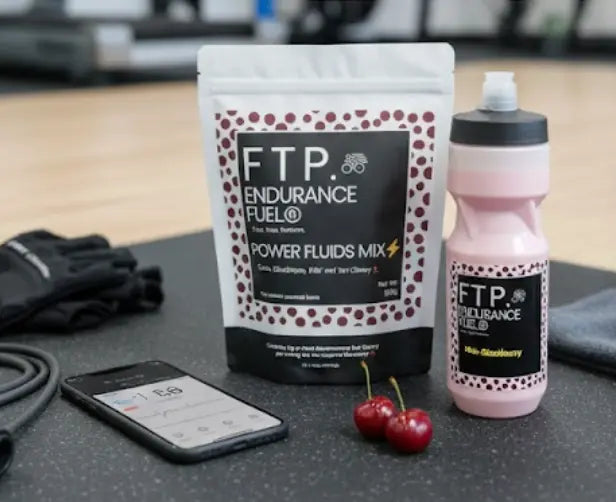
Power Fluids Tart Cherry 900g
3g of real dried Montmorency tart cherry per serving, plus 27g of carbs and 300mg of sodium.
£25.99
Shop now

