

If you've spent any time in endurance sport, you've almost certainly come across tart cherry. It appears in recovery shakes, post-training supplements, and — increasingly — in the fuelling products that athletes carry on rides and long runs. The question most athletes ask is a reasonable one: is this genuinely useful, or is it just another ingredient riding the wave of wellness marketing? The evidence is unusually clear. Tart cherry is one of the few natural compounds in sports nutrition with a robust, replicated body of research behind it.
What separates tart cherry from the noise is consistency. Multiple randomised controlled trials — covering marathon runners, cyclists, and strength athletes — have shown meaningful reductions in muscle soreness, inflammatory markers, and recovery time. This isn't a single small study being stretched across a marketing campaign. For endurance athletes specifically, understanding what tart cherry actually does — and why — is worth the time.
Quick answer: yes — tart cherry genuinely works for recovery. Multiple randomised controlled trials show Montmorency tart cherry reduces muscle soreness, inflammation and strength loss after hard exercise, and it supports sleep thanks to naturally occurring melatonin. Take it twice daily, starting four to five days before a hard event and continuing two to three days after.
What Makes Tart Cherry Different from Sweet Cherry?
Precision matters here, because not all cherries are equal. The variety used in virtually all the peer-reviewed research is Montmorency tart cherry (Prunus cerasus), a sour cultivar grown predominantly in North America and parts of northern Europe. Compared to sweet cherries, Montmorency contains significantly higher concentrations of anthocyanins — the pigments responsible for the deep crimson colour and, more importantly, for the measurable physiological effects on recovery.
 Anthocyanins are a class of polyphenols with potent antioxidant and anti-inflammatory activity. In Montmorency tart cherry, the two most studied are cyanidin-3-glucosylrutinoside and cyanidin-3-rutinoside. These compounds inhibit the COX-1 and COX-2 enzymes — the same biochemical pathways targeted by non-steroidal anti-inflammatory drugs like ibuprofen — without the gastrointestinal side effects that come with habitual NSAID use. For athletes who routinely reach for ibuprofen after hard sessions, tart cherry represents a meaningful natural alternative with a cleaner risk profile.
It's also worth noting that the anthocyanin content varies considerably between products. Freeze-dried Montmorency concentrate retains the active compounds well, whereas cherry-flavoured products with no specified Montmorency content are unlikely to deliver any meaningful benefit. The variety and concentration matter far more than the format.
What the Research Says About Muscle Recovery and DOMS
The most consistently replicated finding in tart cherry research is its effect on delayed onset muscle soreness (DOMS) and the recovery of contractile strength after exercise-induced muscle damage. A landmark 2010 study published in the Scandinavian Journal of Medicine and Science in Sports found that marathon runners who consumed Montmorency tart cherry juice for five days before and two days after a marathon reported significantly lower pain scores than the placebo group — and recovered muscle function faster in the 48 hours post-race.
An earlier study by Connolly et al. (2006) looked at strength athletes performing eccentric bicep curls — a reliable protocol for inducing DOMS — and found that those consuming tart cherry juice lost significantly less strength in the days following the session compared to controls. For endurance athletes, the implication is direct: faster recovery between training sessions, reduced accumulated fatigue across a training block, and the ability to absorb higher training loads without systemic inflammation compounding over weeks.
The effective dose used in most studies sits around 30ml of Montmorency concentrate (equivalent to roughly 60 whole cherries) taken twice daily. Timing matters: studies showing the strongest effects begin supplementation four to five days before a hard effort and continue for two to three days afterwards. For regular training, daily use throughout a build phase appears to compound the benefit over time.
| Phase | When | Protocol from the research |
| Pre-event loading | 4–5 days before a hard effort | ~30ml Montmorency concentrate equivalent (≈60 cherries), twice daily |
| Event day | Race or key session day | Continue the twice-daily dose |
| Post-event | 2–3 days after | Keep dosing through the DOMS window (soreness peaks at 24–48 hours) |
| Build phase | Daily through heavy training blocks | Consistent daily use appears to compound the benefit over time |
Sleep and Oxidative Stress: Two Overlooked Benefits
Recovery is not just about managing muscle damage. Two less-discussed but equally important benefits for endurance athletes are tart cherry's effect on sleep quality and its role in managing oxidative stress — both of which have a direct bearing on how much training you can absorb and how quickly you adapt.
Montmorency cherries are one of the few natural food sources of melatonin, the hormone that regulates the sleep-wake cycle. A 2011 study published in the European Journal of Nutrition found that consuming Montmorency tart cherry juice twice daily increased both urinary melatonin levels and total sleep duration in healthy adults, with significant improvements in sleep efficiency. For athletes, sleep quality is arguably the most important recovery variable available. Any dietary strategy that supports sleep architecture without requiring pharmaceutical intervention is worth taking seriously, particularly during heavy training blocks when sleep is already under pressure from accumulated fatigue.
On the oxidative stress side, hard endurance training generates substantial free radical production. While some degree of oxidative stress is a necessary training stimulus, chronic excess impairs adaptation and elevates injury risk. Anthocyanins function as free radical scavengers, and several studies have shown that tart cherry supplementation blunts exercise-induced rises in oxidative stress markers such as malondialdehyde and 8-isoprostane. This is particularly relevant during high-volume periods — stage races, marathon build programmes, Ironman preparation — where oxidative stress accumulates across consecutive days and can compromise the quality of subsequent sessions.
Montmorency tart cherry, built into your bottle
Power Fluids Tart Cherry — 27g of carbohydrate, 300mg of sodium and 3g of real dried Montmorency tart cherry per serving.
Juice, Concentrate, or Supplement: Which Format Works?
The original research was conducted primarily using tart cherry juice or concentrate, but more recent work has validated freeze-dried powder and encapsulated supplements as effective delivery formats. What matters is the anthocyanin content and bioavailability, not the format itself. Juice and concentrate offer slightly higher bioavailability due to the natural food matrix, but a dry format is far more practical for most training and racing scenarios.
There's also a compelling argument for combining tart cherry with carbohydrate. Carbohydrates are essential for glycogen resynthesis after hard efforts, and some evidence suggests that polyphenols may enhance intestinal glucose transport. Practically, incorporating tart cherry into your on-the-go fuelling — rather than taking it as a separate capsule — may be the most efficient approach, delivering carbohydrate and antioxidant support simultaneously at the point when you need both most.
What We Use at FTP Endurance Fuel
We put Montmorency tart cherry into Power Fluids, our carbohydrate and electrolyte drink mix — not as a marketing hook, but because combining carbohydrate delivery with recovery support in a single format made genuine sense for how endurance athletes actually train and race. You're already drinking on the bike or during long runs; why not make that bottle do more than simply top up glycogen and sodium?
Our Power Fluids Tart Cherry (900g) carries 3g of dried Montmorency tart cherry per 30g serving — real fruit, not flavouring — alongside 27g of carbohydrate from dextrose and cane sugar, and 300mg of sodium. That is the product in our range that delivers the anthocyanins described above. It is not a substitute for the twice-daily concentrate protocol used in the studies, and we won't pretend otherwise; what it does is put the cherry alongside fuel you are already taking, in every session, without adding another thing to remember.
One point of precision, because this article is built on the argument that precision matters. Our Tart Cherry Energy Pastilles are tart cherry flavoured. They are a carbohydrate product — roughly 30g of carbs per two-pastille serving from a 1:1 glucose-fructose blend — and we make no recovery claim for them. If you are after the Montmorency itself, it is in the bottle, not the pouch.

Frequently Asked Questions
How much tart cherry should athletes take?
The effective dose used in most studies is around 30ml of Montmorency concentrate — equivalent to roughly 60 whole cherries — taken twice daily. Whatever the format, the Montmorency variety and the anthocyanin content matter far more than whether it is juice, powder or a whole-fruit product.
When should I take tart cherry — before or after exercise?
Both. The studies showing the strongest effects begin supplementation four to five days before a hard effort and continue for two to three days afterwards. For regular training, daily use through a build phase appears to compound the benefit over time.
Does tart cherry help you sleep?
Montmorency cherries are one of the few natural food sources of melatonin, and research found that tart cherry juice twice daily increased melatonin levels, total sleep duration and sleep efficiency in healthy adults — a genuinely valuable side benefit during heavy training blocks.
Is tart cherry the same as regular cherry?
No. Virtually all the peer-reviewed research uses Montmorency tart cherry (Prunus cerasus), a sour cultivar containing significantly higher concentrations of anthocyanins than sweet eating cherries. Cherry-flavoured products with no specified Montmorency content are unlikely to deliver any meaningful benefit.
Which FTP products actually contain Montmorency tart cherry?
Power Fluids Tart Cherry, at 3g of dried Montmorency tart cherry per 30g serving. Our Tart Cherry Energy Pastilles are tart cherry flavoured carbohydrate fuel and do not contain Montmorency tart cherry — we list them as a fuelling product, not a recovery one.
The case for tart cherry for athletes is as well-supported as anything in endurance nutrition. If you're training consistently and want a recovery advantage that doesn't involve expensive protocols or questionable compounds, Montmorency tart cherry is worth making a regular part of your routine. Pre-load for four to five days before your next hard event, continue for two to three days after, and pay attention to how your legs respond in the following sessions. The research suggests you'll notice the difference — and so do most athletes who try it.
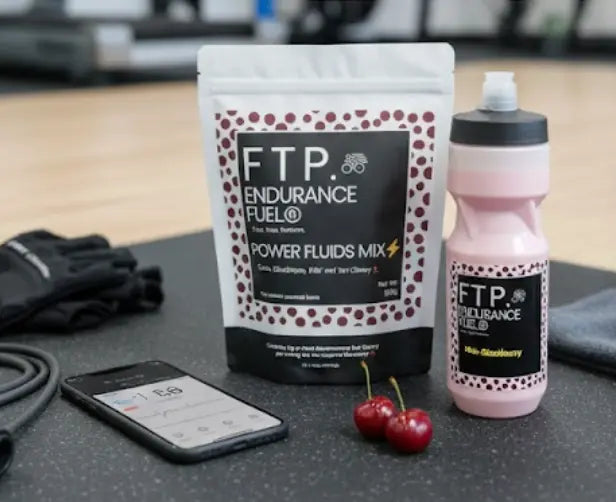
Power Fluids Tart Cherry 900g
3g of real dried Montmorency tart cherry per serving, with 27g of carbs and 300mg of sodium.
£25.99
Shop now
Power Fluids Taster 60g
A sensible starting point before committing to a full 900g tub.
From £4.99
Shop now
